Category: Phone Scams

  • How Scammers Use AI Voice Cloning to Fake Family Emergencies

    How Scammers Use AI Voice Cloning to Fake Family Emergencies

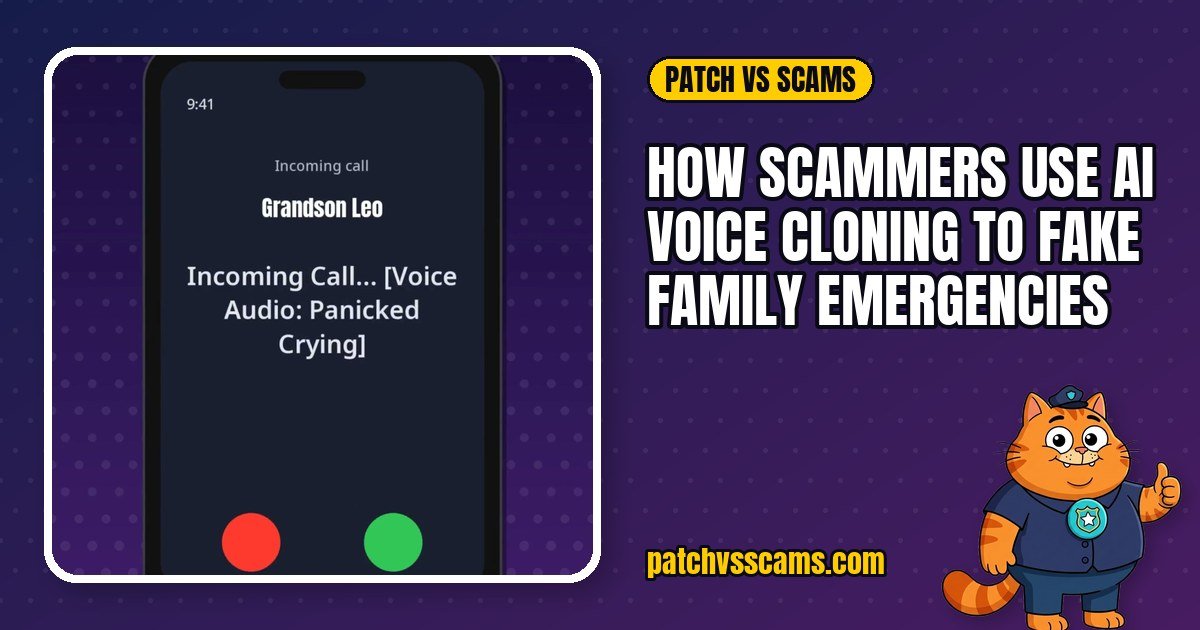
    Hearing a loved one in distress is one of the most frightening experiences imaginable. Fraudsters are now pairing that emotional shock with artificial intelligence, using voice-cloning software to simulate kidnapping, car crashes, or sudden arrests. Knowing how these schemes operate can keep your family safe and your finances secure.

    How the scam works

    Modern voice-cloning tools can work from just a few seconds of clear speech to replicate an individual’s vocal tone, pitch, and cadence. Scammers extract these voice samples from public videos uploaded to social media platforms.

    Once the clone is generated, the scammer calls a relative—often a parent or grandparent—posing as the loved one or an authority figure like an attorney or police officer. The caller claims an immediate crisis has occurred, such as a severe car accident or detention in jail. They demand an instant transfer of funds to resolve the emergency, relying on shock and urgency to prevent the victim from thinking clearly.

    Red flags

    Be on alert if an incoming emergency call exhibits any of the following signs:

    • Extreme emotional pressure: The caller insists money must be sent immediately and begs you not to tell other relatives.
    • Unusual payment methods: Demands to pay via wire transfer, cryptocurrency, peer-to-peer payment apps, or retail gift cards.
    • The voice sounds exactly right: That proves nothing. Good clones can be very convincing, so never rely on how the voice sounds.
    • Refusal to verify identity: The caller resists answering specific personal questions that only the real family member would know.
    • Unfamiliar incoming numbers: The call comes from an unknown number or spoofed caller ID, with the caller claiming their real phone was broken, lost, or confiscated.

    How to stay safe

    Take deliberate, proactive steps to protect your household from voice impersonation:

    • Establish a family safe-word: Agree on a private code word or phrase known only to immediate family. If someone calls claiming an emergency, ask for the safe-word before taking any action.
    • Pause and verify: Resist the urge to act instantly. Hang up and contact the family member directly on their established, trusted phone number.
    • Reach out to mutual contacts: If the relative does not pick up, contact their spouse, roommate, coworker, or school to confirm their whereabouts.
    • Tighten social privacy: Review social media privacy settings and consider limiting public access to videos containing clear audio of your voice.

    If it already happened to you

    If you sent money to an impostor, take these steps right away:

    1. Contact the financial institution, wire service, or payment platform immediately to request a transaction recall or freeze.
    2. Document all records, including call logs, phone numbers, transaction IDs, and payment receipts.
    3. Report the incident to your local police department and obtain a copy of the police report.
    4. Report it: in the US at ReportFraud.ftc.gov; in India at cybercrime.gov.in or helpline 1930; elsewhere, to your national fraud reporting service.

    Frequently asked questions

    Can scammers clone a voice from a quick phone greeting?

    It’s possible, and you can’t control every recording of your voice. That’s why the reliable defence is verification, not secrecy: a family safe-word and calling back on a number you already know.

    What if the caller claims my relative cannot speak because of an injury?

    This is a standard tactic designed to explain away voice discrepancies or avoid conversation entirely. Never send funds based solely on an unknown third party’s claims; always verify independently through trusted contacts.

    Watch Patch explain it

    New cartoon scam alerts every week on YouTube: youtube.com/@PatchVsScams

    This article is general safety information, not legal or financial advice. See our Disclaimer for where to report scams.
  • The Bank Impersonation Trap: Why Scammers Demand Your One-Time Passcode

    The Bank Impersonation Trap: Why Scammers Demand Your One-Time Passcode

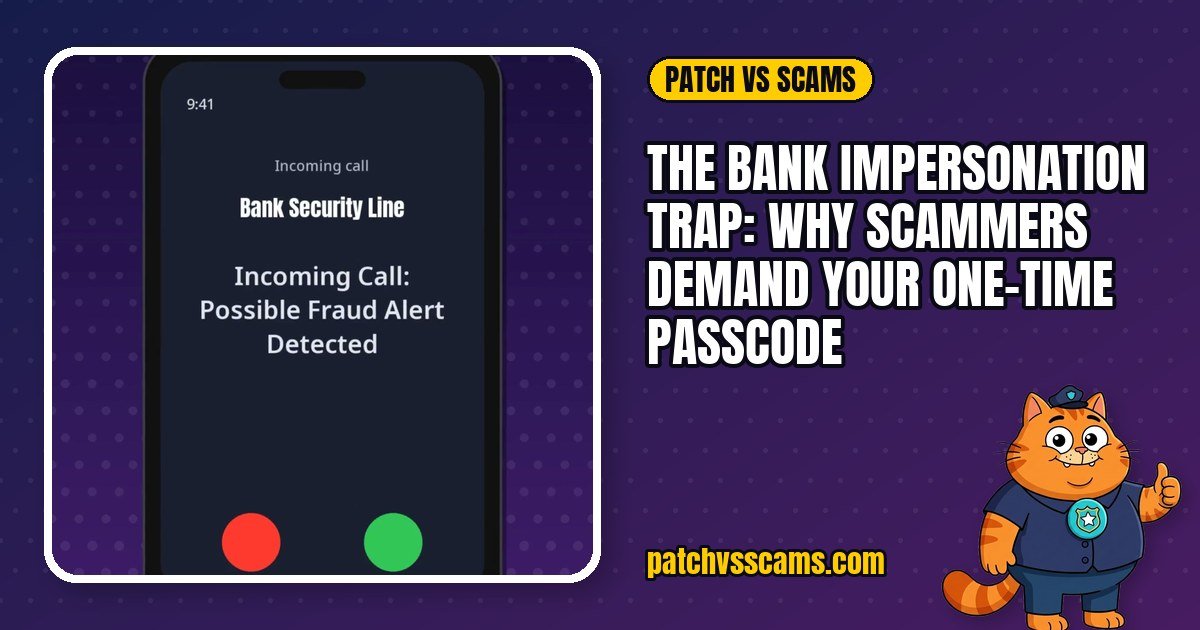
    A ringing phone displays the name of your financial institution, complete with a local or recognized number. The person on the other end speaks with urgency, claiming that fraudulent charges are actively draining your checking account. To stop the crime, they claim they need to verify your identity using a quick security code sent to your phone. It feels official, helpful, and urgent. In reality, it is one of the most widespread phone scams happening today.

    How the scam works

    This scheme relies on caller ID spoofing combined with psychological pressure. Fraudsters use widely available software to alter the outgoing caller ID, making the call appear to originate from your bank’s legitimate customer service or fraud prevention department.

    Before placing the call, the criminal typically has already obtained your login credentials, card details, or phone number through data breaches or phishing emails. However, they are blocked by two-factor authentication. To complete an unauthorized transaction or wire transfer, the criminal triggers a verification code from your genuine banking service to your mobile device.

    The caller then invents a scenario where an unauthorized purchase must be blocked. They instruct you to read back the code you just received. When you supply those numbers, the criminal enters them into the real banking portal, authorizing the transfer or password change on their end. Within minutes, money can leave your account.

    Red flags

    • The caller insists on remaining on the line while a text message arrives.
    • The text message containing the code explicitly says “Do not share this code with anyone,” yet the caller claims bank staff need it.
    • Extreme urgency or fear tactics, such as claiming all your funds will vanish within minutes if you disconnect.
    • The caller asks you for sensitive details like your card PIN, CVV, or complete online banking password to “confirm identity.”
    • The caller becomes aggressive, irritated, or refuses to let you hang up and call back.

    How to stay safe

    • Never share verification codes: Banks say their staff will never call you and ask you to read out a one-time passcode.
    • Hang up immediately: If someone claims to be from your bank regarding suspicious activity, disconnect the call.
    • Verify independently: Locate the official phone number printed on the back of your payment card or on your monthly statement. Dial that number directly to verify the account status.
    • Protect your login data: Use a password manager to generate unique, complex passwords for your financial accounts so leaked passwords do not compromise your profile.

    If it already happened to you

    1. Contact your bank immediately using the phone number on the back of your card. Inform the fraud team that your credentials and a verification code were compromised so they can freeze accounts and reverse unauthorized transactions where possible.
    2. Update your account passwords, security questions, and linked email credentials from a secure device.
    3. Place a temporary fraud alert or credit freeze with the major credit bureaus to prevent the creation of new fraudulent accounts in your name.
    4. Report it: in the US at ReportFraud.ftc.gov; in India at cybercrime.gov.in or helpline 1930; elsewhere, to your national fraud reporting service.

    Frequently asked questions

    Can my bank help me recover the funds?

    Banks look at unauthorized transfers case by case. Reporting it as fast as possible gives you the best chance of stopping or disputing the transfer.

    How did the caller know my bank and name?

    Personal information is frequently compiled from third-party data breaches, commercial marketing lists, or social media, allowing criminals to personalize their script before calling.

    Watch Patch explain it

    New cartoon scam alerts every week on YouTube: youtube.com/@PatchVsScams

    This article is general safety information, not legal or financial advice. See our Disclaimer for where to report scams.

  • Fake Customer Service Numbers in Search Results: How the Scam Works

    Fake Customer Service Numbers in Search Results: How the Scam Works

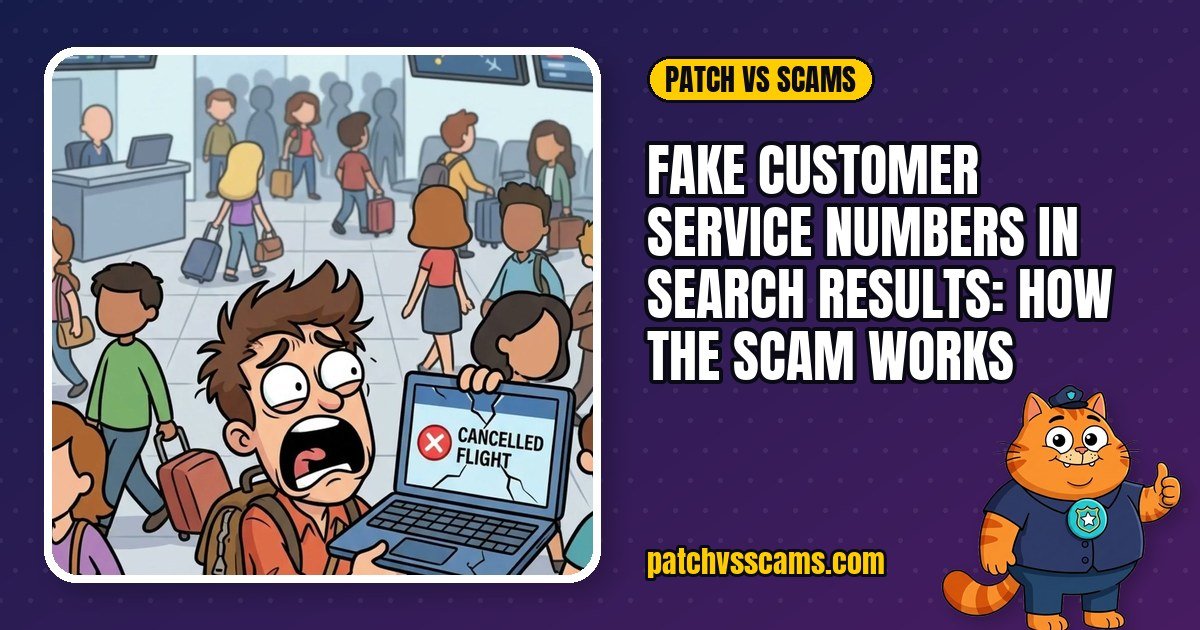
    When a flight is cancelled or an account is locked, most of us grab our phone and search for the company’s helpline. Scammers know this. They buy search ads and publish fake listings so that their phone number is the first one you see, and then pretend to be the company when you call.

    How the scam works

    Search engines show paid ads above the normal results. Scammers pay to appear there for searches like “airline customer service number” or “bank helpline”, often using the real company’s name in the ad. The number goes to a call centre run by fraudsters. They sound professional, confirm your problem is “urgent”, and then ask for a fee, your card details, a one-time code, or remote access to your computer or phone.

    Red flags

    • The number came from a search result, not from the company. The US Federal Trade Commission warns: don’t assume the phone number that comes up in a search is legitimate.
    • The top results are marked “Sponsored” or “Ad”. Paid listings are not a sign of trust. Scroll past them and check the web address.
    • The web address is slightly off, such as extra words, hyphens, or an unfamiliar ending like `sky-help-service-desk.net`.
    • They ask you to install an app such as a remote-desktop tool “to fix” a billing or booking problem.
    • They want payment by gift card, crypto, wire transfer or a payment app. Real companies don’t ask for this.
    • They ask for a password, PIN or one-time code. A real support agent never needs these.

    How to find the real number

    1. Type the company’s web address yourself, or use its official app.
    2. Use the number printed on your bill, booking confirmation, or the back of your card.
    3. If you must search, scroll past the ads and check the address carefully before calling.

    If it already happened to you

    1. Hang up.
    2. Call your bank or card provider using the number on the back of your card, and ask them to block the card or dispute the payment.
    3. If you gave remote access, disconnect the device from the internet, uninstall the app you were told to install, run a security scan, and change your passwords from a different, trusted device.
    4. Report it: in the US at ReportFraud.ftc.gov; in India at cybercrime.gov.in or helpline 1930; elsewhere, to your national fraud reporting service.

    Frequently asked questions

    Can an ad blocker stop this scam?

    It can hide sponsored results, which helps, but it isn’t a full fix: fake numbers also appear in normal listings, maps, and forum posts. The reliable fix is to get the number from the company itself.

    Why do fake support ads get through?

    Ad platforms review ads, but fraudsters keep creating new accounts and change their pages after approval. That’s why the safest habit is not to trust any number from a search result.

    Sources

    Watch Patch explain it

    New cartoon scam alerts every week on YouTube: youtube.com/@PatchVsScams

    This article is general safety information, not legal or financial advice. See our Disclaimer for where to report scams.